


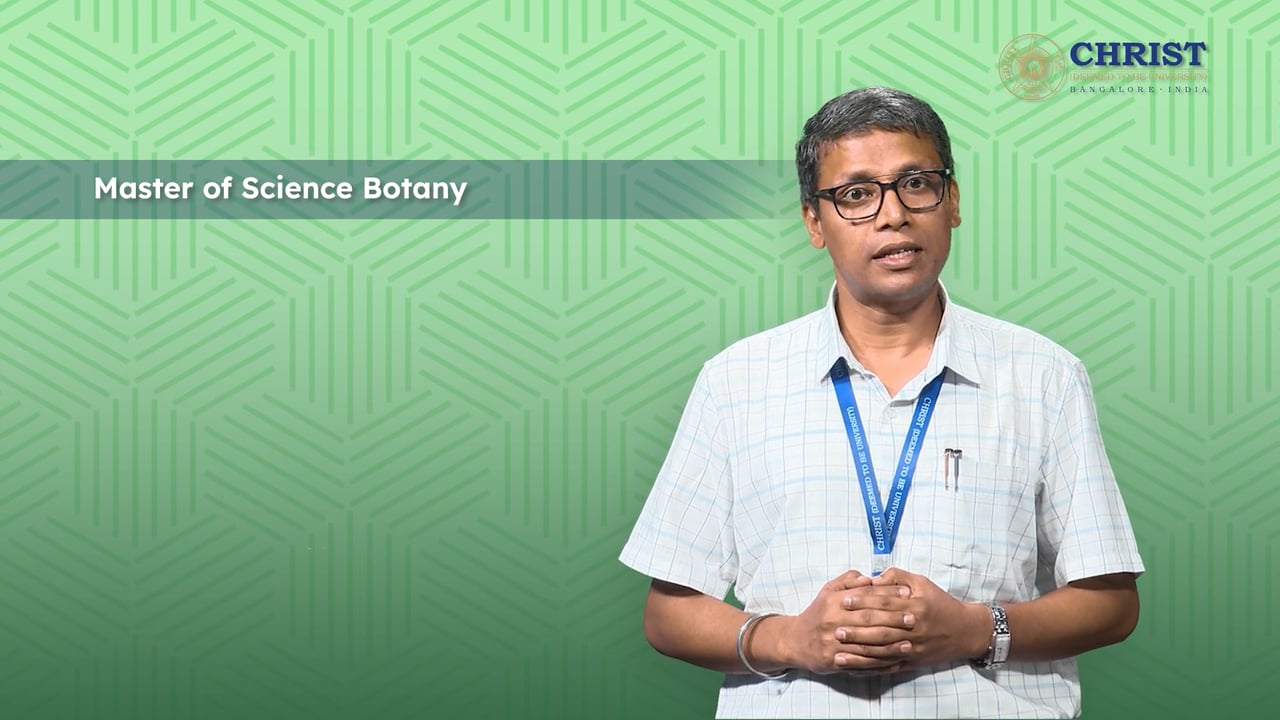
About the Programme
M.Sc (Plant Science and Biotechnology) program provides a comprehensive understanding of various aspects of plant such as plant anatomy, physiology, taxonomy, genetics ecology and biotechnology. The programme provides an in-depth understanding of the concepts and practical skills for better understanding of plant complexity, diversity and their ecological interaction. On graduation students are able to identify the plant species, growth pattern and the phytochemicals to explore their potential application in industries. Students will be able to appreciate the phytochemicals to treat various diseases. Students are experiencing a rich industrial and research exposure as they undergo summer internship and research projects in various industries and institutions. The constant update in curriculum with latest developments caters and career guidance will cater to the needs of aspirants of NET and other competitive exams.
Advanced Study of Plant Sciences
The programme provides comprehensive knowledge of plant biology, ecology, biotechnology, and environmental sustainability.
Practical and Research-Based Training
Students gain extensive laboratory and field experience through research projects, ecological studies, and applied botanical techniques.
Focus on Conservation and Sustainable Development
The curriculum highlights biodiversity conservation, medicinal plants, and sustainable agricultural and environmental practices.
Career and Research Advancement Opportunities
The programme equips students for advanced careers in research, environmental management, agriculture, and higher academic pursuits.
Why Choose This Programme?
Critical Thinking
The programme develops the ability to analyze biological and environmental challenges through logical reasoning and scientific inquiry.
Analytical Skills
Students gain expertise in interpreting experimental data, conducting field investigations, and applying modern botanical techniques.
Self-Directed and Long-Term Learning
The curriculum encourages independent learning and continuous skill enhancement to adapt to evolving scientific advancements.
Scientific Communication
The programme strengthens technical writing, presentation, and scientific discussion skills essential for research and professional growth.
Application of Knowledge
Students learn to apply botanical concepts and research methodologies to agriculture, conservation, and environmental management.
Skills for Socio-Economic Benefits
The programme equips learners with practical and research-oriented skills that contribute to sustainable development and societal welfare.
Choose Your Track
Develops practical skills in plant propagation, genetic improvement, and in vitro culture techniques
Provides knowledge of medicinal plants, phytochemicals, and economically important plant resources
Strengthens scientific research skills through field surveys, experimental design, and data analysis
What You Will Learn
Programme Structure
The programme structure outlines the academic curriculum designed to provide a systematic progression of learning through core subjects, electives, and practical components across semesters, ensuring both theoretical understanding and skill development.
Semester 1 — Semester 1
Semester 2 — Semester 2
Semester 3 — Semester 3
Semester 4 — Semester 4
Eligibility & Fee Structure
Career Paths
Your Career Roadmap
Select a specialisation track to explore the learning journey and career outcomes tailored to your chosen domain.
Year 1 – Foundation in Plant Biotechnology
Students develop fundamental knowledge and practical skills in plant tissue culture, molecular biology, genetics, and laboratory techniques.
Year 2 – Advanced Research and Industrial Applications
Students gain specialized training in micropropagation, genetic improvement, plant transformation, and research-based biotechnology applications.
Year 1 – Understanding Medicinal and Economic Plant Resources
Students acquire foundational knowledge of medicinal plants, phytochemistry, ethnobotany, and economically important plant species.
Year 2 – Applied Research and Herbal Product Development
Students gain practical exposure in phytochemical analysis, herbal formulation, conservation strategies, and industrial applications of plant resources.
Year 1 – Foundation in Scientific Research and Field Methods
Students develop skills in experimental design, ecological surveys, biodiversity assessment, and scientific data collection techniques.
Year 2 – Advanced Research and Ecological Analysis
Students strengthen expertise in statistical analysis, environmental monitoring, field-based research projects, and scientific reporting.
Message from the HOD

Bangalore Central Campus
The Department of Life Sciences is a unique department in the CHRIST (Deemed to be University) where interdisciplinary teaching and research in Life sciences have established permanent roots. It is a diverse discipline that covers all branches of Biotechnology, Botany, Zoology and Forensic Science in a dominant manner.
The Department of Life Science is one of the oldest Departments in the University, started from the inception of the institution in 1969. The Department has extremely competent faculty actively involved in advanced re
Message from the HOD
The Department of Life Sciences is a unique department in the CHRIST (Deemed to be University) where interdisciplinary teaching and research in Life sciences have established permanent roots. It is a diverse discipline that covers all branches of Biotechnology, Botany, Zoology and Forensic Science in a dominant manner.
The Department of Life Science is one of the oldest Departments in the University, started from the inception of the institution in 1969. The Department has extremely competent faculty actively involved in advanced research covering Bioprocess technology, Plant Biotechnology, Microbial Biotechnology, Environmental Biotechnology, Aquaculture, Wildlife biology, Animal Behaviour, Forensic Anthropology, Question Documents, Forensic Psychology, Forensic Ballistics etc.
The academic programmes have been highly ranked by reputed external agencies and have wide public acceptance. We, at the Department of Life sciences, constantly strive to enrich our syllabus and programs to remain at the forefront of current trends in higher education.
All the courses in each of the programmes have been carefully designed to equip the students for competitive exams like JAM, GATE, CSIR NET, SET etc. and also to write research proposals for grants. I invite you to explore our Department website to cognize the academic and research excellence of the Department. With this message, I would like to wish the student community a very successful experience together with us in the Department.
Admission Process
- Register with your Email ID
- Login to the Admission Portal
- Fill the Application Form
- Pay Application Fee
- Entrance Test (If Applicable)
- Assessment
- Interview
- Check login page for result
- If selected, Offer Letter attached
- Pay Course Fee Online
- Complete Admission Process
Ready to Apply?
Applications are open. Deadline: 2026-12-06 23:45:00.